Inkberry
The native half flower, and the reason you should look twice at what is already on your dune
Scaevola plumieri
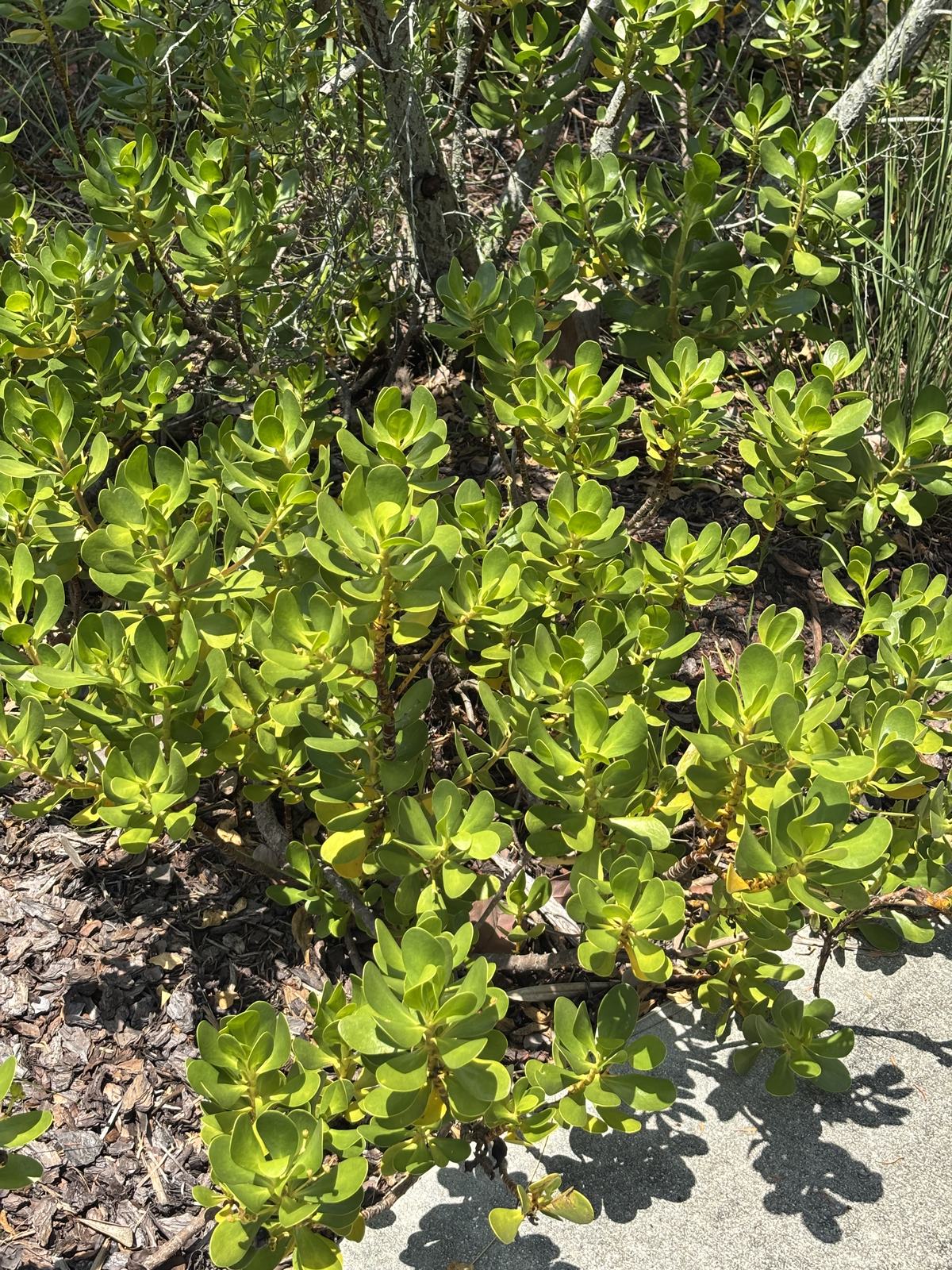
Photo: Longleaf Design
Why it works here
Here is the story on this plant, and it is one of my favorites to tell. Inkberry is our native beach scaevola: thick fleshy glossy leaves, white half flowers with all the lobes fanned to one side, and shiny black fruit year round, which is where the ink comes from. It is state listed threatened. And the reason it is threatened is standing right next to it on most dunes in South Florida. Beach naupaka, Scaevola taccada, was pushed for coastal landscaping in the seventies and early eighties, escaped by the early eighties, and now forms dense stands on beach dunes all over the state, crowding out sea oats, sea lavender, beach peanut, and this plant specifically. It is a Category I invasive. The mechanism is not complicated: the invasive grows much faster and makes hundreds to thousands of flowers per plant while our native makes ten to fifty. It just overwhelms it. And the Treasure Coast CISMA runs an active removal project on our barrier island, at Coral Cove, MacArthur Beach, Hobe Sound, and Blowing Rocks, and they specifically treat adjacent private properties, because the preserves are not connected to each other and they get reinfested from people's yards. Which means what is in your yard is not just about your yard.
Care
Poor, sharp draining, alkaline sand, full sun, and light water only through the first dry season. Do not amend the bed and do not put it on a lawn irrigation schedule. A sand or shell mulch beats wood mulch here. Plant on three to four foot centers and be patient, because it is slow and it will take two or three seasons to fill.
Common problems
Root rot in wet, rich, poorly drained soil. The fix is grade and siting, not a product.
Slow establishment. Nothing to do but plan for it.
Storm surge. It takes all the salt spray you can throw at it, but prolonged salt water over the roots will kill it. There is no cultural fix, you replant.
No significant pests or disease. UF says nothing is of major concern, which is exactly the point of planting natives.
Common questions
I already have this on my dune. Do I need it?
You probably have the invasive, and almost everybody does. Look at the fruit, because that is the single best tell: our native has black fruit, beach naupaka has white to yellowish white fruit. Native leaves are generally under three inches, thick and stiff and glossy with smooth edges. The invasive gets leaves up to eight inches with wavy rolled under edges and a little notch at the tip, and it grows into a big bushy mound up to sixteen feet. What is not a tell is the half flower. They both have it, and that is exactly why this confusion has gone on for forty years.
If the invasive is already there, is it worth planting the native?
Yes, and it is worth removing the other one. Contractors doing that removal work charge somewhere around six hundred to fifteen hundred dollars a day, so it is not nothing. But the honest truth is the invasive is cheaper and easier to buy than the native, which is most of why this keeps happening.
Can I take a piece off the beach?
No. It is state listed threatened, the dune vegetation is what is holding the sand in place, and the whole reason this plant is in trouble is people treating the coast as a nursery. Buy nursery propagated stock. It is a special order, but it is gettable from the growers an hour south of us.
Interested in a inkberry in your landscape?
We plan, install, and care for it. Start with a paid consultation.