
Pineland Croton
The only food two endangered butterflies can eat, and a straight answer about whether they will show up
Croton linearis
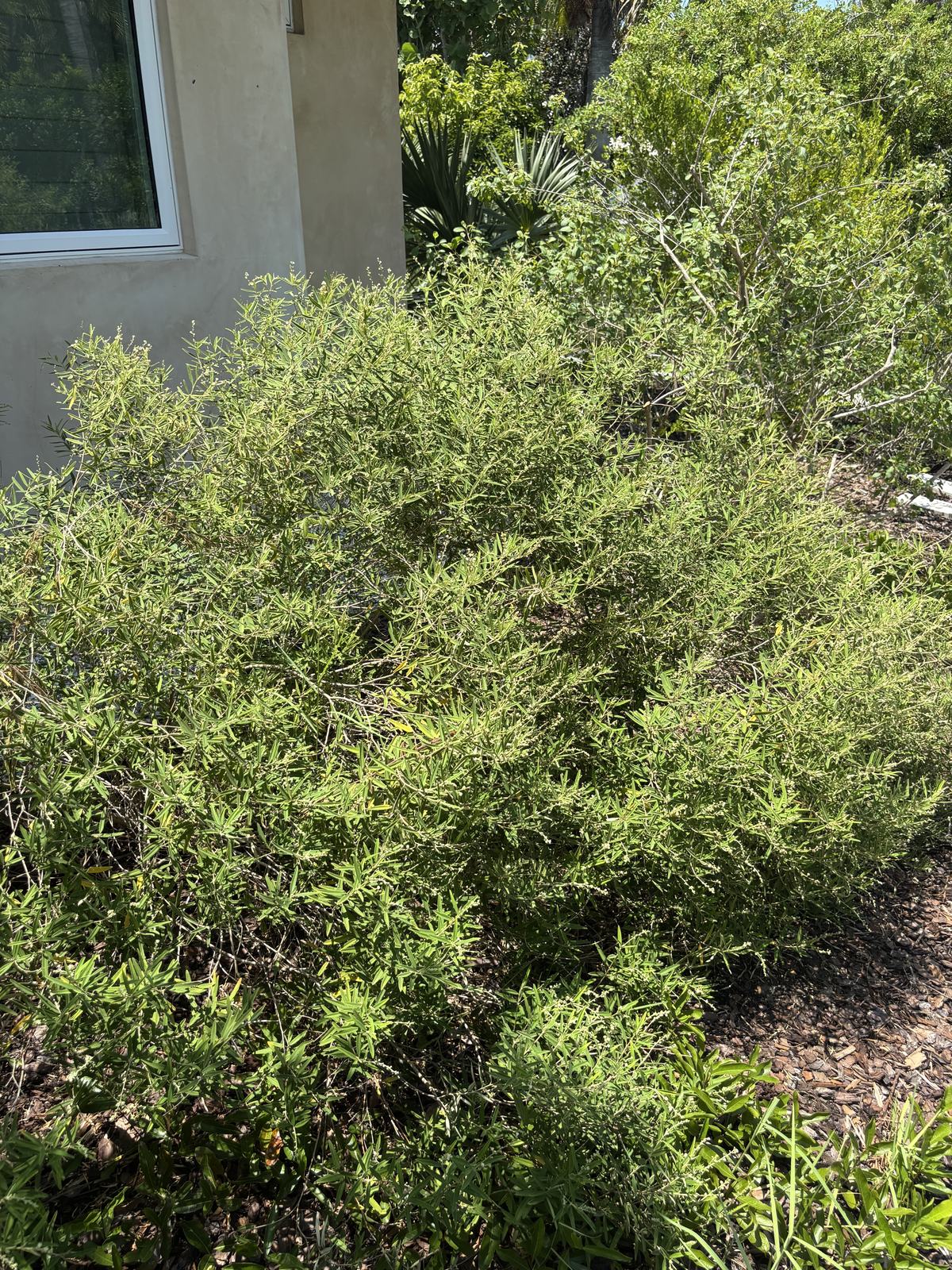
Photo: Longleaf Design
Why it works here
First, forget everything you picture when you hear croton. This is nothing like the loud red and yellow hedge shrub in every strip mall parking lot in Florida. That is Codiaeum, a completely different plant. This one is quiet: narrow dark green leaves with silvery to coppery undersides, so the whole shrub flashes two tone when the wind moves it. Small white flowers all year long. Now the story. Pineland croton is the only larval host plant on earth for two federally endangered butterflies, Bartram's scrub-hairstreak and the Florida leafwing. Not the preferred host, the only one. US Fish and Wildlife says both depend exclusively on it. And I have to be honest with you about what that means here, because I have seen this plant sold on a promise it cannot keep. Both butterflies are gone from Martin County and have been for decades. The Florida leafwing now exists in exactly one place on earth, Long Pine Key in Everglades National Park, about 130 miles south of us, with a population estimated in the hundreds. They are not coming to your garden. Planting this in Stuart is not butterfly conservation and I am not going to sell it to you that way. What it is: putting a locally extirpated native back in its own county. Martin County is in the documented historic range, and this plant is presumed gone from the wild in St. Lucie County right next door. Pine rockland habitat is down about 90 percent since 1900. That is worth doing on its own, and the plant earns its place in a garden without any butterfly story attached.
Care
Poor, sharply drained, sandy or limestone soil with no humus in it. Full sun. No compost in the hole, no fertilizer, irrigation only to establish. It comes from high pH rockland but it adapts to our acid sand fine. Growth is moderate to fast, which is a relief after most of this list. If a freeze burns the tips, cut back in spring rather than replacing.
Common problems
Cold at our latitude. The nursery trade rates it 10b and up, which is a half zone warmer than us, though the historical record puts it here. Site it on the south or southeast side of something, out of frost pockets.
Root rot in an irrigated, amended bed. Poor and dry is the assignment.
Mosquito spraying. If a client is running a spray everything mosquito service, this plant and everything near it is a dead zone for the insects it is meant to feed. US Fish and Wildlife lists mosquito control insecticide among the primary threats to Bartram's scrub-hairstreak. I would rather lose the job than pretend that is compatible.
Common questions
Will I get the endangered butterflies?
No. I want to be the one who tells you that instead of you finding out in a year. Both are extirpated from this county and one is down to a single site in the Everglades. Plant it because it is a rare Martin County native with a remarkable story, and because it is a good looking, tough, year round blooming shrub. Not because of a butterfly that is not coming.
Is this the croton from the garden center?
No relation at all. Same common name, completely different plant. This one is a native shrub with narrow dark leaves and silver undersides, and the resemblance to that variegated hedge is exactly zero.
Should I plant more than one?
Yes, at least three. Sources disagree on whether plants are strictly male and female or whether both flower types occur on one plant, so I am not going to state it as settled. Three plants from more than one source covers you either way if you want seed.
Interested in a pineland croton in your landscape?
We plan, install, and care for it. Start with a paid consultation.