
Orange Geiger
Orange flowers most of the year on a salt proof small tree, and a beetle that will chew on it
Cordia sebestena
Whether this tree is native to Florida is disputed. The USF Atlas says no. FNPS and the Institute for Regional Conservation say it was in the Keys before the Spanish. I list it with the natives and tell you both sides.
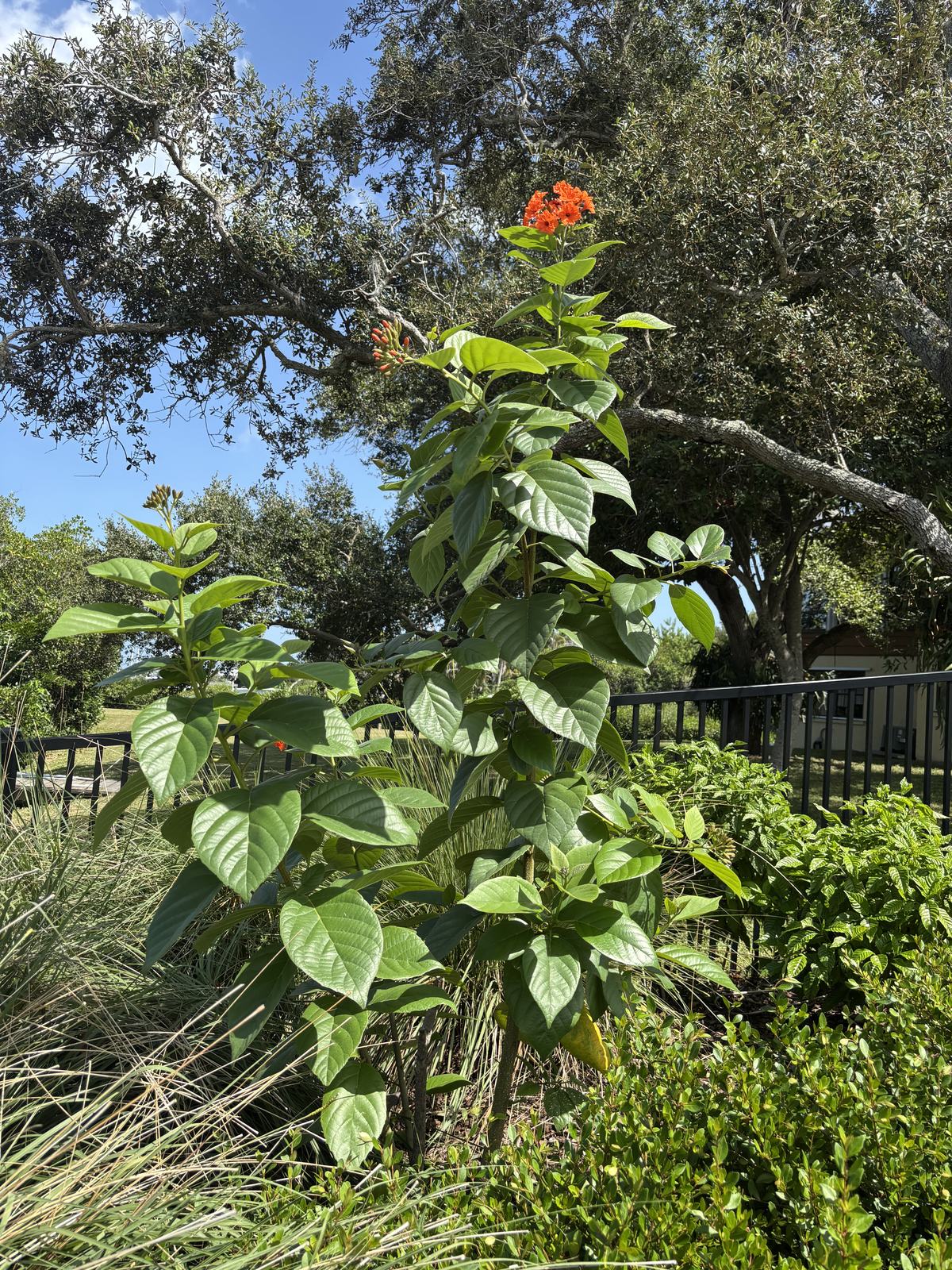
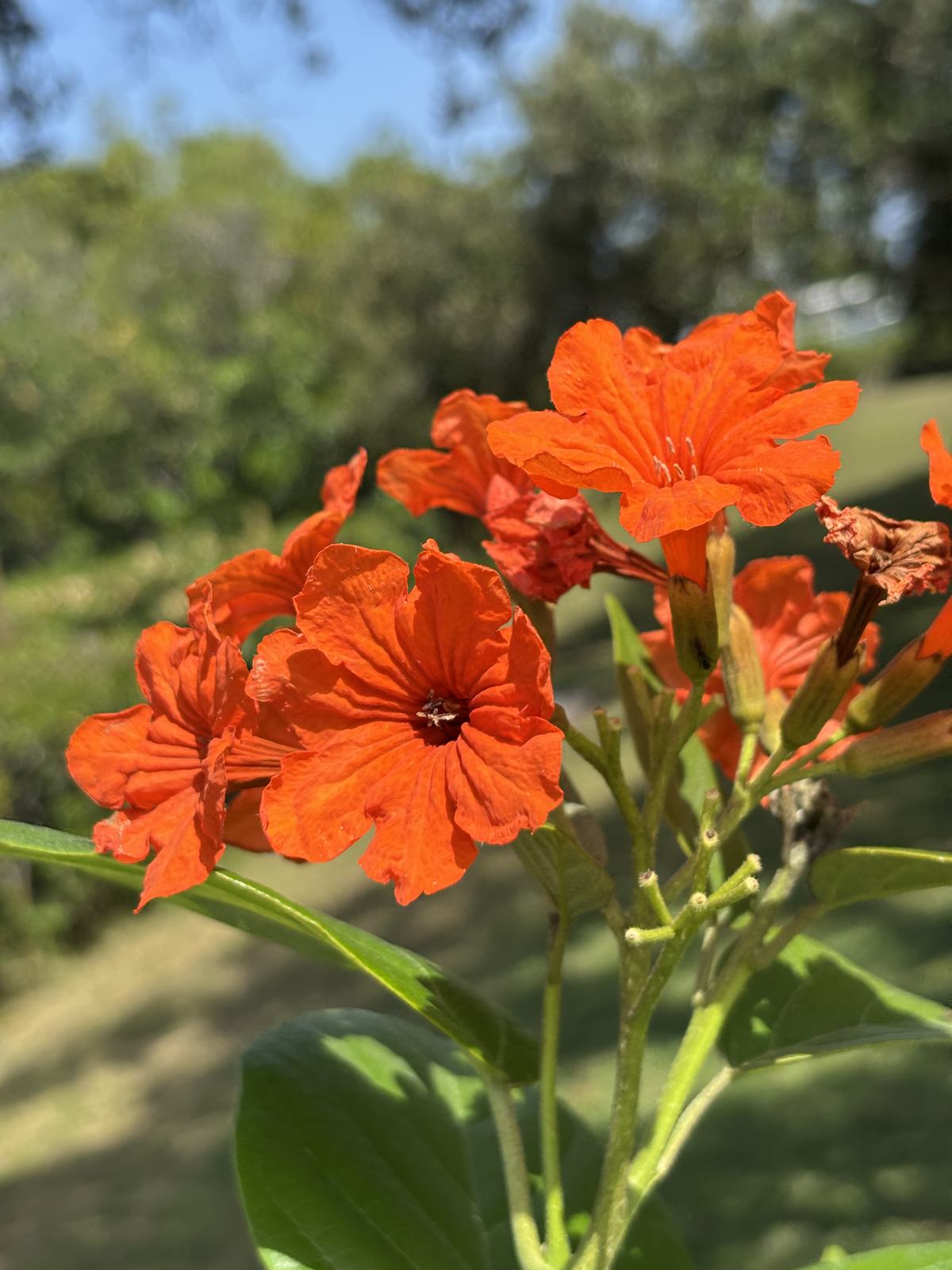
Why it works here
Big clusters of orange red funnel flowers, two inches across, most of the year and heaviest in summer and fall, on a rounded small tree with thick sandpapery leaves. Hummingbirds work it, the large orange sulphur and Schaus' swallowtail take nectar from it, and white crowned pigeons eat the white fruit. That pigeon is the whole native argument, actually. FNPS and IRC reason that since the fruit floats and that bird carries it, geiger tree almost certainly reached the Keys on its own, long before anybody planted it. The USF Atlas disagrees and calls it not native. I am not going to settle a botany argument on a landscaping website. What I will tell you is that it is not on any invasive list, it takes salt wind like almost nothing else with flowers this size, and it has one of the best stories of any tree in Florida: Captain John Geiger's 1830 house in Key West, where Audubon painted a white crowned pigeon sitting in this tree and named the tree for the family. Honest part: we are north of its comfort zone and there is a beetle that will eat it. Both below.
Care
Full sun, sharp drainage, limestone or shelly sand if you have it. Water to establish, then take it off irrigation. Train it to a single trunk while it is young, because multi trunk geigers split in storms. Prune only to shape and remove crossing branches. Keep it out of any spot where cold air settles, and give it the warmest, most protected place you have. A wall with a southern exposure near the water is ideal.
Common problems
Cold. UF says do not plant it anywhere there is the slightest danger of frost, and Stuart gets frost some winters. This is a barrier island and Intracoastal plant here, not an inland one.
The geiger tortoise beetle. It feeds only on this tree, and UF's Collier County office has watched it skeletonize 20 to 30 percent of a canopy in a normal year and up to 90 percent in a bad one, with peaks in spring, midsummer, and early fall. The trees recover. Heavy feeding cuts next year's bloom. I do not spray for it. If you want a geiger that the beetle ignores, the Texas white geiger is the substitute, but it is not native to anything near here.
Fruit litter. White inch long fruit drops and it is a little messy on a patio.
Splitting. Single trunk, always.
Common questions
Is it native or not?
The honest answer is that the experts disagree and I have told you who says what. It belongs in the Keys either way, it is not invasive, and it is one of the best salt wind flowering trees there is. Plant it for that.
Something is eating the leaves. Should I spray?
Probably the tortoise beetle, and no. The tree recovers, the beetle only eats this one plant, and spraying a tree in bloom for a cosmetic problem is not something I will do.
Will it survive a Stuart winter?
Near the water in a protected spot, usually. Inland in a low open yard, I would not bet your money on it. Put it in the right place or pick something else.
Interested in a orange geiger in your landscape?
We plan, install, and care for it. Start with a paid consultation.