
Sabal Palm
The state tree, and the toughest thing you can put in a Florida yard
Sabal palmetto
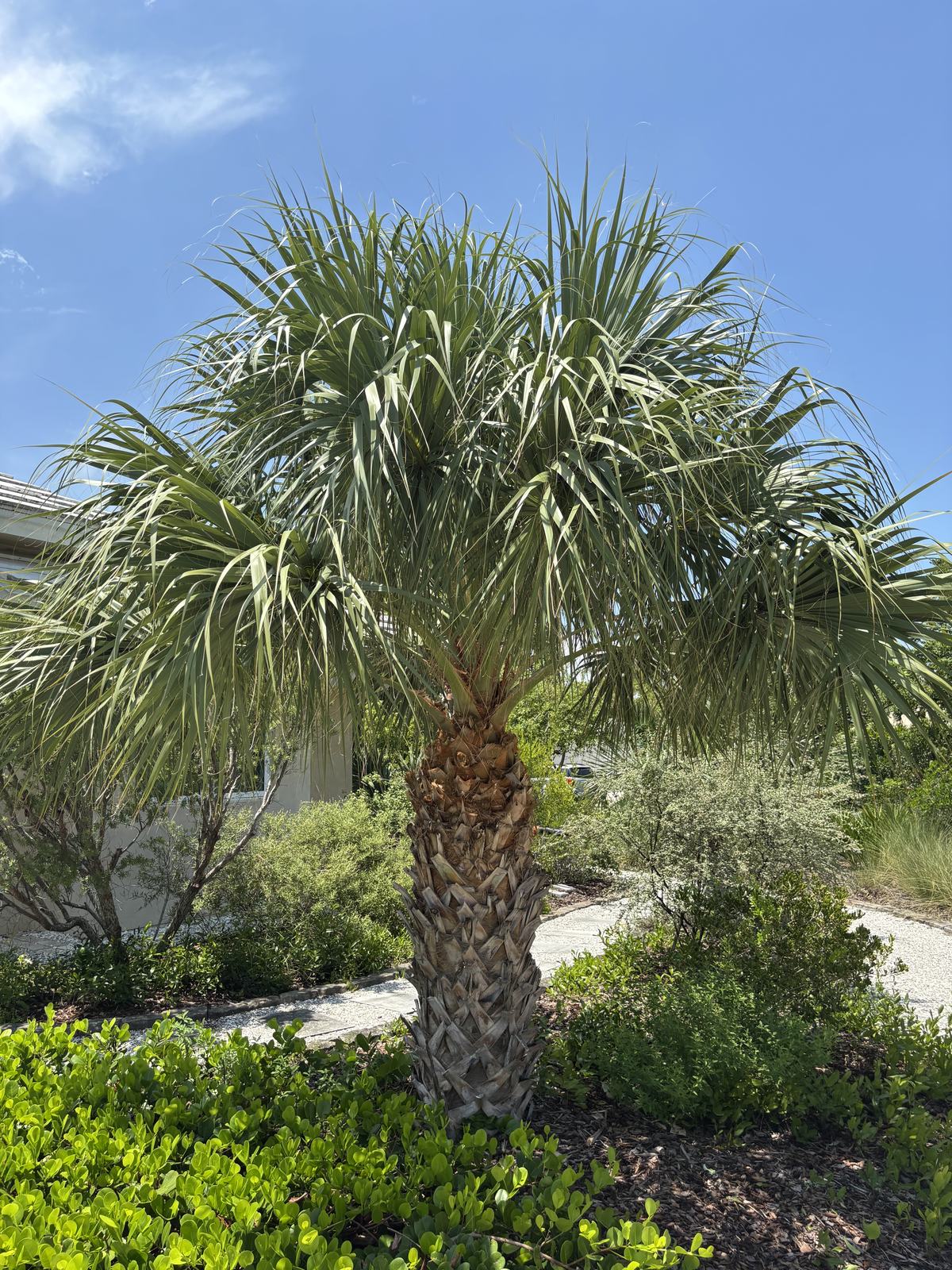
Photo: Longleaf Design
Why it works here
This is the Florida state tree and it grows wild in Martin County, which means it asks nothing of you. Full sun or deep shade, drought or standing water, it does not care. It is also the highest wildlife value plant on this whole list. Thousands of creamy white flowers come in late spring and the bees work them hard, black fruit follows in late summer for the birds, it is the larval host for the monk skipper butterfly, and if you leave the dead frond bases on, called boots, yellow bats will roost in them. Birds nest in the crown. Nobody grows one of these to size in a pot, so a sabal is a palm you buy field dug and plant, and it is the cheapest palm in Florida by a wide margin. Here is the honest part: it is messy. Fronds drop, flower stalks drop, fruit drops, and seedlings come up everywhere. If you want a tidy palm this is not it.
Care
Water it through establishment, which takes eight months or more because the palm has to rebuild its whole root system after transplant, then leave it alone. Do not use climbing spikes on it and do not wound the trunk, because that is how trunk rot gets in. Skip the fertilizer unless the fronds tell you otherwise. If you do feed, palms want a slow release 8-2-12 with 4 percent magnesium three times a year, not lawn fertilizer. And keep high nitrogen turf fertilizer away from the root zone entirely, because it will drive a potassium deficiency in a palm standing thirty feet away.
Common problems
Potassium deficiency is the number one issue and it shows as yellow orange spotting and brown tips on the oldest fronds, never the new ones. People see yellowing and water more, which does nothing. The fix is proper palm nutrition and patience.
Lethal bronzing is real and I am not going to soften it. It is a bacteria like organism spread by a planthopper, sabal palm is a confirmed host, and it has been found in dozens of Florida counties. There is no organic cure. The only treatment is an antibiotic trunk injection every three to four months forever, which is a chemical program and a permanent cost. What I can do is design against it: never plant a row of one palm species, keep the palms healthy, and remove an infected one fast.
Ganoderma butt rot has no cure either. You will see a shelf shaped conk on the lower trunk. Remove the palm, grind the stump, and do not put another palm in that spot.
Strangler figs germinate in retained boots and can eventually kill the palm. Worth a look every couple of years.
Common questions
Should I get it hurricane cut?
No. That tight pruned look where they strip it down to a few upright fronds is a handling practice for shipping palms, not a care practice. Over pruning drives potassium deficiency and the palm takes a year or two to recover. There is one exception: at transplant, research out of UF found that removing all the leaves raised survival to 95 percent versus 64 percent when a third were left on. So a freshly planted one looks rough on purpose.
My fronds are yellowing. Does it need water?
Almost never. Yellow orange spotting on the oldest fronds is a potassium deficiency, and more water will not touch it. Look at which fronds are affected. Oldest means nutrition, newest means something more serious.
Everyone has these. Why would I plant one on purpose?
Because familiarity is not the same as low value. This is the plant with the most wildlife use in your yard, it will still be standing after a storm that takes down your neighbor's queen palm, and it costs a fraction of anything comparable. Common and good are allowed to be the same thing.
Interested in a sabal palm in your landscape?
We plan, install, and care for it. Start with a paid consultation.